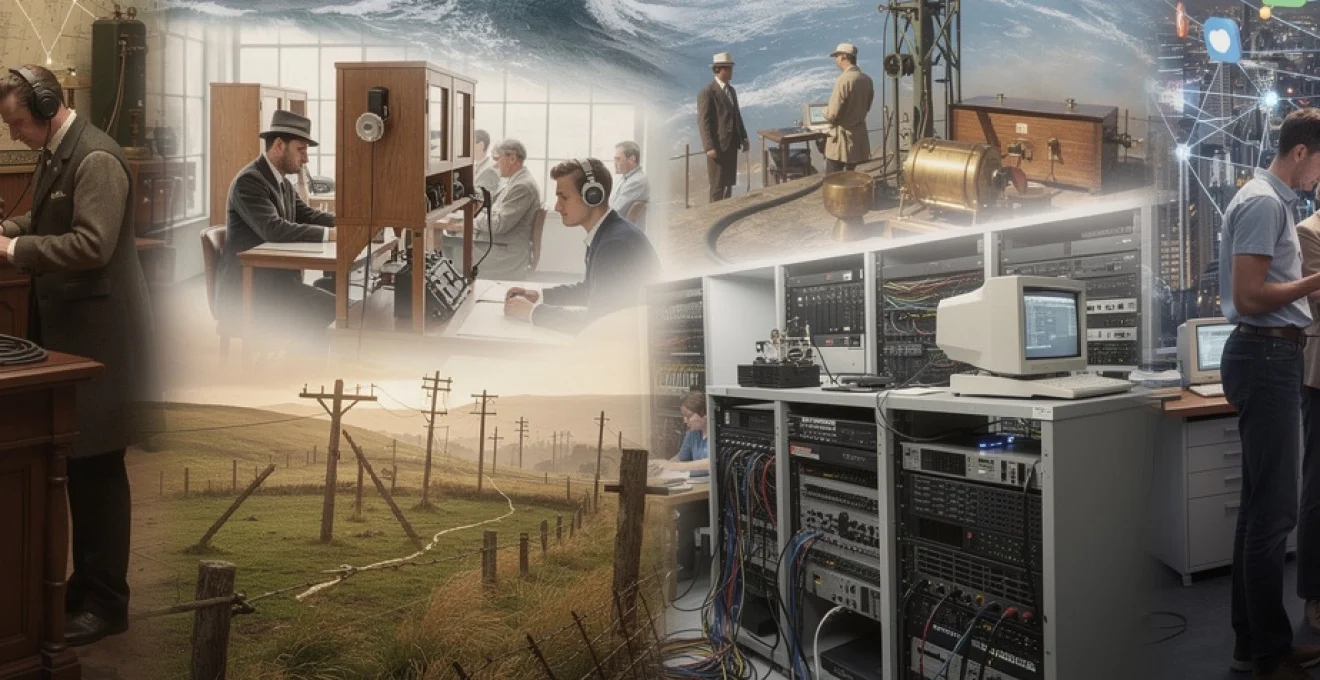
The transformation of human communication from primitive gestures to sophisticated digital networks represents one of the most remarkable engineering achievements in history. Over the past two centuries, revolutionary breakthroughs in telecommunications have fundamentally altered how people connect, conduct business, and share information across vast distances. These technological leaps didn’t merely improve existing methods – they created entirely new possibilities for human interaction that continue to shape modern society.
From the first electromagnetic pulses transmitted across telegraph wires to today’s lightning-fast 5G networks, each innovation built upon previous discoveries whilst simultaneously opening doors to previously unimaginable applications. The journey from Victorian-era telegraph networks to contemporary social media platforms demonstrates humanity’s relentless pursuit of faster, more reliable, and increasingly sophisticated communication methods.
Telegraph networks and morse code implementation in victorian britain
The telegraph revolution began in earnest during the 1840s, fundamentally transforming Victorian Britain’s communication landscape. This electromagnetic marvel allowed messages to travel hundreds of miles in minutes rather than the days required by traditional postal services, creating the first truly instantaneous long-distance communication system.
Samuel morse’s electromagnetic telegraph system development
Samuel Morse’s ingenious electromagnetic telegraph system combined scientific principles with practical engineering solutions. His apparatus utilised electrical pulses transmitted through copper wires to activate electromagnets at receiving stations, which then moved mechanical arms to mark paper tape with dots and dashes. The system’s brilliance lay in its simplicity – operators needed only to understand the binary nature of electrical signals to transmit complex messages across vast distances.
Morse’s breakthrough came from recognising that electrical current could be interrupted and restored in precise patterns, creating a digital communication method decades before the term « digital » entered common usage. The electromagnetic relay stations amplified signals every few miles, ensuring message integrity across transcontinental distances. This innovation proved so robust that telegraph networks operated reliably for over a century, with some systems remaining functional well into the computer age.
Transatlantic cable project and cyrus west field’s engineering challenges
Cyrus West Field’s ambitious transatlantic cable project represented Victorian engineering at its most audacious. The endeavour required laying over 2,000 miles of specially designed cable across the Atlantic Ocean floor, connecting Europe and North America for the first time through instantaneous electrical communication. Field’s team faced unprecedented challenges, including extreme ocean depths, powerful currents, and the need to manufacture cable capable of withstanding immense underwater pressure.
The project’s initial attempts ended in failure when cables snapped during installation or ceased functioning within weeks of completion. However, Field’s persistence ultimately triumphed in 1866 with the successful installation of a durable transatlantic telegraph cable. This achievement reduced communication time between London and New York from weeks to minutes, revolutionising international commerce and diplomacy whilst proving that human ingenuity could overcome seemingly impossible engineering obstacles.
Great western telegraph company’s infrastructure expansion across europe
The Great Western Telegraph Company spearheaded Europe’s telegraph infrastructure expansion through systematic network development and strategic partnerships. Their comprehensive approach involved establishing relay stations at regular intervals, training skilled operators, and implementing standardised procedures across multiple countries. The company’s network eventually connected major European cities, creating an integrated communication system that facilitated rapid information exchange across national borders.
This infrastructure expansion required careful coordination between engineers, government officials, and local communities. Telegraph poles and underground cables transformed landscapes whilst creating new employment opportunities for operators, maintenance technicians, and administrative staff. The social impact extended beyond mere convenience – telegraph networks enabled coordinated railway operations, improved weather forecasting, and allowed newspapers to report international events within hours of occurrence.
Morse code standardisation and international telegraph alphabet adoption
The standardisation of Morse code represented a crucial step towards global communication interoperability. International telegraph conferences established uniform coding systems, ensuring messages could be transmitted seamlessly between different countries and telegraph companies. The adoption of standardised timing intervals, signal patterns, and operational procedures eliminated confusion and reduced transmission errors significantly.
Professional telegraph operators developed remarkable proficiency in Morse code transmission and reception, often achieving speeds exceeding 25 words per minute. This human-machine interface created the first generation of skilled technology workers, establishing precedents for training programmes and professional certification systems. The international telegraph alphabet became so widely adopted that it influenced radio communication protocols well into the twentieth century, demonst
ed that concise, standardised signalling could bridge not only continents but also different communication technologies.
Alexander graham bell’s telephone patent and early switching systems
While the telegraph compressed communication from weeks to minutes, Alexander Graham Bell’s telephone shrank it further to real-time conversation. His 1876 patent for the telephone marked a pivotal shift from coded electrical pulses to the direct transmission of the human voice. Instead of interpreting dots and dashes, people could now speak naturally and be heard almost instantly across town – and, increasingly, across countries. This transition from symbolic to vocal communication laid the foundation for the modern global telephone network.
Bell telephone company’s manual exchange operations in boston
The first commercial telephone exchanges, such as those operated by the Bell Telephone Company in Boston, relied entirely on manual switching. Early subscribers were connected via a central office where human operators – often young women chosen for their perceived politeness and clarity of speech – physically inserted plugs into jack panels to complete each call. When you lifted the receiver, a small indicator dropped on the operator’s board, prompting the familiar question: « Number, please? »
These manual exchanges were feats of both engineering and organisation. Switchboards had to handle increasing call volumes, manage limited line capacity and maintain acceptable call quality. Training programmes standardised operating procedures to ensure speed and accuracy, much like telegraph offices had done with Morse code. As telephone density grew in urban areas, the limitations of purely manual systems became apparent, paving the way for mechanical and, later, electronic switching technology.
Strowger automatic exchange technology and mechanical switching
The Strowger automatic exchange, patented in the 1890s by undertaker Almon B. Strowger, introduced a radical concept: eliminating the need for manual operators in routine call connection. Strowger suspected that human operators were directing calls to rival businesses, so he devised a mechanical solution that put control directly in the hands of the caller. His system used a series of electromechanical relays and stepping switches that responded to pulses generated by a rotary dial.
Each turn of the rotary dial created a specific number of electrical interruptions, which drove the switches step-by-step to the correct vertical and horizontal position on a bank of contacts. In effect, the caller « programmed » the route of their own call using what we would now recognise as a primitive form of digital signalling. Although noisy and maintenance-intensive, Strowger exchanges dramatically increased network capacity and reliability. They also set the precedent for automated switching techniques that would later be implemented electronically in digital telephone exchanges.
Long-distance trunk line development and signal amplification methods
Early telephones worked well over short distances, but voice signals weakened rapidly as line lengths increased. To create truly national and international telephone networks, engineers needed reliable long-distance trunk lines and efficient amplification methods. The first solution involved thicker copper conductors and loading coils – carefully spaced inductors that reduced signal loss over long runs of cable. These innovations made coast-to-coast voice calls in countries like the United States and long trunk lines in Europe technically feasible.
The invention of the vacuum tube amplifier in the early 20th century transformed long-distance telephony. Repeaters housing vacuum tubes were installed at intervals along trunk lines, boosting weakened signals without requiring manual intervention. This was similar in concept to telegraph relay stations but far more sophisticated in execution. As amplification and cable technology improved, undersea telephone cables followed the path laid by telegraph cables, enabling intercontinental voice calls. By the mid-20th century, a business leader in London could speak directly with a partner in New York, fundamentally changing expectations around global communication speed.
Party line systems and rural telephone network deployment
In rural areas, building dedicated lines for every household was economically challenging. The solution was the party line system – a shared telephone circuit serving multiple subscribers. Each household on a party line had its own distinctive ring pattern, allowing people to identify whether an incoming call was for them. While this arrangement dramatically reduced infrastructure costs and extended telephone access to remote communities, it also raised new issues around privacy and etiquette.
Party lines highlight how social norms evolve alongside communication technology. Conversations could be overheard if neighbours quietly lifted their receivers, and disputes sometimes arose over « hogging » the line. Yet for many rural communities, party lines were a lifeline, enabling faster access to medical help, coordination of agricultural activities and stronger social ties. Over time, as infrastructure investment increased and switching technologies advanced, individual private lines became the norm, but the party line era remains a powerful example of how engineering compromises can still deliver substantial social benefits.
Wireless transmission breakthroughs and marconi’s radio communications
Even as telephone and telegraph wires spanned continents, engineers dreamed of communication without physical conductors. Wireless transmission promised to overcome geographical barriers such as oceans, mountains and sparsely populated regions where laying cables was impractical or prohibitively expensive. Guglielmo Marconi emerged as the most prominent pioneer of practical radio communication, turning theoretical work on electromagnetic waves into robust systems that could send signals through the air over unprecedented distances.
Guglielmo marconi’s spark-gap transmitter innovations
Marconi’s early radio systems relied on spark-gap transmitters, devices that generated bursts of radio-frequency energy when an electrical spark jumped between two electrodes. Each spark produced a broad spectrum of electromagnetic waves, which were then radiated by an antenna. At the receiver end, a sensitive device such as a coherer detected the incoming pulses and triggered a relay or sounder, often used to reproduce Morse code.
What set Marconi apart was not the invention of the spark-gap itself – which others had explored – but his methodical approach to antenna design, grounding and tuning. By optimising the height and configuration of aerials, he significantly extended transmission range. He also experimented with tuned circuits so that transmitter and receiver resonated at similar frequencies, improving selectivity and reliability. In much the same way that early telegraph engineers iterated on wire quality and insulation, Marconi refined every component of his wireless systems until they could compete with, and in some cases outperform, wired communication over open water.
Transatlantic wireless signal achievement at poldhu station
One of Marconi’s most celebrated feats occurred in 1901, when he received the first transatlantic wireless signal at Signal Hill in Newfoundland, sent from the Poldhu station in Cornwall, England. The message was simple – the three dots of the Morse letter « S » – but its significance was enormous. It demonstrated that radio waves could travel far beyond the visual horizon, apparently following the curvature of the Earth. At the time, many scientists doubted such transmission was possible over 3,000 kilometres of open ocean.
The Poldhu experiment involved a powerful transmitter and a large, complex antenna array, supported by masts that had to withstand coastal weather. The receiving setup in Newfoundland was comparatively modest, relying on a long wire antenna and a sensitive coherer. Although later analysis suggested that atmospheric conditions and reflections in the upper atmosphere played a crucial role, Marconi’s success accelerated investment in wireless communication. Naval fleets, merchant ships and coastal stations rapidly adopted radio, enhancing safety at sea and enabling more responsive coordination of maritime traffic.
AM radio broadcasting and crystal detector receiver technology
As radio technology matured, engineers moved from simple on-off keying of Morse code to more sophisticated methods like amplitude modulation (AM), which varied the strength of a carrier wave in step with audio signals. AM radio broadcasting allowed music, news and spoken word content to be transmitted to many listeners simultaneously, transforming radio from a point-to-point communication tool into a powerful mass medium. This shift paralleled the way printed newspapers had previously centralised and distributed information to large audiences.
On the receiving side, crystal detector radios offered an affordable and accessible way for households to tune into broadcasts. These receivers typically used a piece of crystalline mineral, such as galena, and a fine « cat’s whisker » wire to form a primitive semiconductor junction. Though simple, this arrangement could detect AM signals without requiring external power. Hobbyists and schoolchildren built crystal sets from mail-order kits, learning basic electronics in the process. In many ways, crystal radios were the Raspberry Pi of their era – low-cost, educational and instrumental in inspiring the next generation of engineers and operators.
Shortwave propagation discovery and ionospheric reflection principles
The discovery of shortwave radio propagation and its interaction with the ionosphere unlocked a new dimension of global communication. Engineers and scientists found that radio waves in certain frequency ranges could be refracted – or « bounced » – by charged layers in the upper atmosphere, allowing signals to travel far beyond the line of sight. By carefully choosing frequencies and transmission angles, operators could send signals around the world using relatively modest power levels.
Understanding ionospheric reflection required a blend of physics, atmospheric science and practical experimentation. Operators noticed that certain frequencies worked better at night or during specific solar conditions, leading to the development of propagation forecasts. Shortwave bands became essential for international broadcasting, amateur radio and long-distance maritime and aviation communication. The idea that our messages could literally « skip » around the planet added a new layer of resilience and reach, foreshadowing the redundant, multi-path design philosophy at the heart of today’s internet and satellite networks.
Digital revolution through ARPANET and internet protocol development
By the mid-20th century, telephone and radio networks were well established, but they were largely analogue and often optimised for a single type of traffic, such as voice or Morse code. The digital revolution emerged from a different direction: computing. As computers became more powerful, researchers began exploring ways to connect them, enabling shared access to resources and distributed processing. This quest gave birth to ARPANET, a pioneering packet-switched network funded by the U.S. Advanced Research Projects Agency (ARPA) in the late 1960s.
Unlike traditional circuit-switched telephone systems, ARPANET divided data into small packets, each routed independently across the network. This approach was more resilient – if one path failed, packets could take alternative routes, much like cars navigating around a traffic jam. In 1969, the first message was sent between nodes at UCLA and Stanford, marking a modest but historic step towards today’s internet. As more universities and research institutions joined, engineers faced a key challenge: how could different networks with different designs communicate seamlessly with one another?
The answer lay in the development of the Transmission Control Protocol/Internet Protocol (TCP/IP), championed by Vint Cerf and Bob Kahn in the 1970s. TCP/IP created a standard « language » for moving data across heterogeneous networks, encapsulating packets so that they could traverse various underlying technologies without losing coherence. IP handled addressing and routing, while TCP ensured reliable delivery, reordering packets and requesting retransmission when necessary. You can think of TCP/IP as the global postal system of the digital world, defining addresses, packaging rules and delivery guarantees so that information can travel from any sender to any receiver.
On 1 January 1983, ARPANET officially adopted TCP/IP, a date often considered the birth of the modern internet. Over the following decade, additional building blocks such as the Domain Name System (DNS) and Tim Berners-Lee’s World Wide Web gave the internet a user-friendly interface. By the mid-1990s, web browsers and email clients had brought digital communication into homes and offices worldwide. Today, over 5 billion people are estimated to use the internet, relying on it for everything from high-stakes financial transactions to casual instant messaging – a scale of interconnectedness that would have been unthinkable in the days of Morse and Marconi.
Mobile communication networks from 1G to 5G implementation
As the internet matured, another revolution unfolded in parallel: mobile communication networks. These systems freed telephony and data services from fixed physical locations, letting people stay connected while on the move. Each generation of mobile technology – from 1G to 5G – has increased capacity, speed and flexibility, steadily turning the mobile phone from a simple voice device into a powerful, pocket-sized computer. The evolution of mobile communication networks has arguably had more impact on everyday life than any previous communication technology.
First-generation (1G) networks, deployed in the 1980s, were analogue systems designed primarily for voice calls. They offered limited capacity, minimal security and no real data capability, but they proved that cellular architecture – dividing territories into overlapping cells served by base stations – could support large numbers of mobile users. Second-generation (2G) networks in the 1990s digitised the radio link, greatly improving call quality and enabling services like SMS text messaging. Few could have predicted that these short text messages would become a dominant communication tool, with billions sent daily worldwide.
Third-generation (3G) networks, rolled out in the early 2000s, introduced mobile internet access and multimedia capabilities. Suddenly, users could browse the web, send images and access email from their phones, albeit at modest speeds by today’s standards. Fourth-generation (4G) LTE (Long Term Evolution) took this further, offering broadband-like speeds and low latency, making high-quality video streaming, real-time navigation and app-based services practical on the go. By the late 2010s, it was normal to expect reliable, high-speed mobile data in most urban areas – something that would have seemed astonishing only a decade earlier.
Fifth-generation (5G) networks represent another step-change, designed not just for human users but also for machines. With theoretical peak speeds in the multi-gigabit range and latency that can drop below 10 milliseconds, 5G opens doors to applications like remote surgery, autonomous vehicles and dense Internet of Things (IoT) deployments. Network slicing allows operators to create virtual sub-networks tailored to specific requirements, such as ultra-reliable low-latency communication for industrial automation. Of course, these advances bring challenges too: operators must invest in denser infrastructure, particularly small cells in urban environments, and address legitimate concerns around security, privacy and energy consumption. Yet as we look ahead to experimental 6G concepts, it is clear that our expectation of being « always connected » will only deepen.
Social media platforms and real-time global connectivity impact
On top of the physical and digital communication infrastructure, a new layer has emerged over the past two decades: social media platforms. While telegraph networks connected institutions and early telephones linked households, social media connects individuals and communities at a global scale, in real time. Platforms such as Facebook, X (formerly Twitter), Instagram, TikTok and LinkedIn sit on top of the internet and mobile networks, turning every smartphone into a broadcast station and every user into both a consumer and creator of content.
This shift has dramatically altered how news spreads, how brands engage with customers and how social movements organise. A single post can reach millions of people within hours, bypassing traditional gatekeepers like broadcasters and newspaper editors. For businesses, this creates unprecedented opportunities for direct engagement and agile communication strategies. For individuals, it offers ways to maintain relationships across continents, find like-minded communities and share personal experiences instantly. At the same time, the sheer volume and speed of information present new challenges around misinformation, echo chambers and digital fatigue.
Real-time global connectivity also blurs the boundaries between work and personal life. Many of us now receive professional updates, family messages and breaking news alerts on the same device, within the same few minutes. This can be empowering, but it can also be overwhelming. Building healthy digital habits – such as setting notification boundaries, verifying sources and taking regular offline breaks – is becoming as important as understanding the technology itself. When we use social media deliberately, it can augment human connection rather than replace it, complementing older communication forms like phone calls, letters and face-to-face conversations.
From the disciplined rhythm of Morse code to the frenetic pace of social feeds, revolutionary advances in communication technology have reshaped everyday life at every step. As new innovations emerge, the central question for each of us is not just what these tools can do, but how we choose to use them to connect more meaningfully with one another.