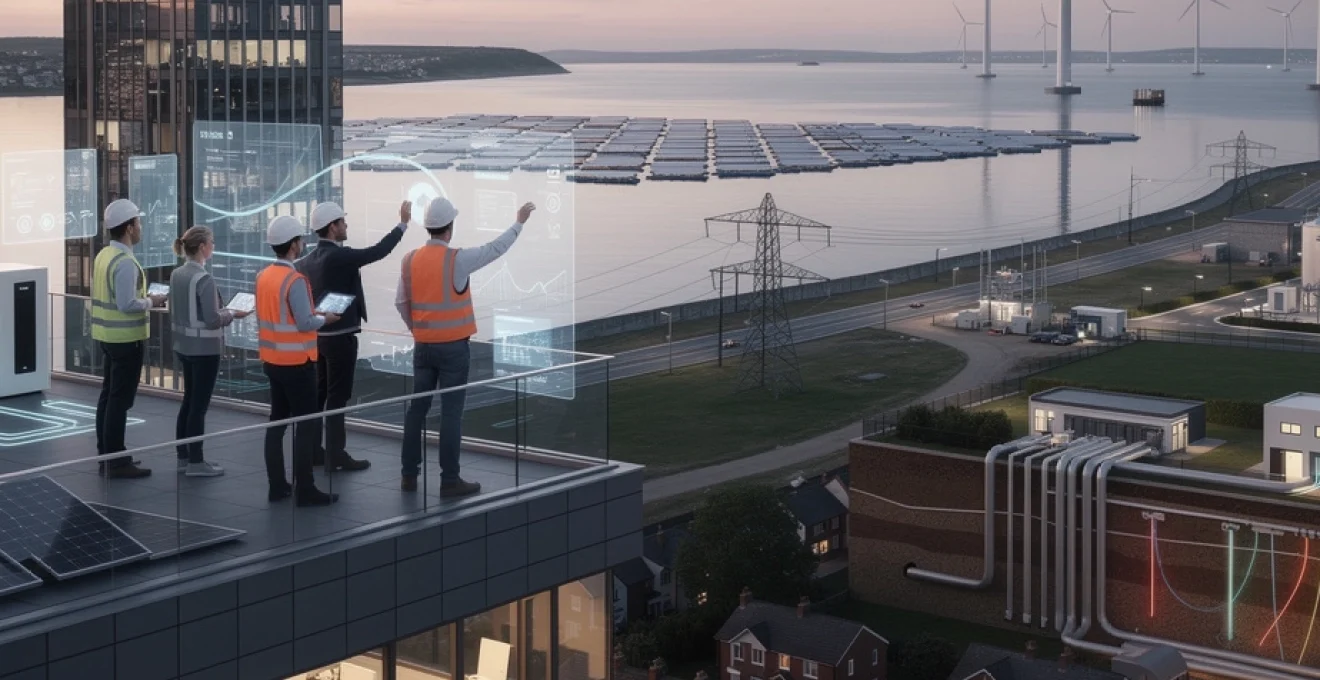
The global energy landscape is experiencing a fundamental transformation as renewable technologies become increasingly integral to infrastructure development. With renewable energy capacity additions reaching 741 gigawatts in 2024—the largest annual increase ever recorded—the integration of solar, wind, geothermal, and hydrogen systems into urban and industrial environments is no longer a futuristic aspiration but a present-day imperative. This shift is driven not merely by environmental concerns but by the compelling economics of renewable technologies, the necessity for energy security, and the practical demands of rapidly growing electricity consumption. As data centres proliferate, electric vehicles reshape transportation, and artificial intelligence drives unprecedented power requirements, the infrastructure supporting these technologies must evolve accordingly. The challenge facing engineers, developers, and policymakers is not whether to integrate renewables, but how to do so efficiently, reliably, and at scale.
Solar photovoltaic systems integration in urban development projects
Solar photovoltaic technology has emerged as the dominant force in renewable energy expansion, accounting for more than three-quarters of new global capacity additions in 2024. This dominance reflects both the precipitous decline in technology costs and the remarkable versatility of solar installations across diverse urban and commercial environments. The integration of solar systems into existing and new infrastructure presents unique opportunities and challenges that require careful consideration of panel efficiency, installation methodologies, energy storage capabilities, and grid connectivity.
Monocrystalline vs polycrystalline panel efficiency in commercial installations
The selection between monocrystalline and polycrystalline solar panels represents a critical decision point for commercial installations, with implications for space utilization, energy yield, and long-term financial returns. Monocrystalline panels, manufactured from single-crystal silicon, typically achieve efficiencies of 20-22%, with premium models reaching 24% under laboratory conditions. Their superior performance in limited space scenarios makes them particularly valuable for urban rooftop installations where every square metre counts.
Polycrystalline panels, produced from multiple silicon fragments melted together, generally deliver efficiencies of 15-17%. While their lower efficiency might suggest inferior performance, the cost differential—typically 10-15% less expensive than monocrystalline alternatives—makes them economically attractive for large-scale commercial installations with abundant roof space. The temperature coefficient, which measures performance degradation in hot conditions, slightly favours monocrystalline technology, an important consideration for installations in heat-island urban environments where roof surface temperatures can exceed 70°C during summer months.
Building-integrated photovoltaics (BIPV) in london’s canary wharf district
Building-Integrated Photovoltaics represent an evolution beyond traditional rack-mounted systems, incorporating solar cells directly into building envelopes as functional architectural elements. The Canary Wharf district in London has become a proving ground for BIPV applications, with developments incorporating photovoltaic glass façades, solar canopies, and integrated roof systems that serve dual purposes as both weather protection and energy generation infrastructure. These installations demonstrate how aesthetic integration and energy production can coexist in premium commercial real estate.
BIPV systems typically generate between 100-200 kWh per square metre annually in the UK climate, depending on orientation and shading. While this represents approximately 15-20% lower output than optimally-angled roof-mounted systems, the elimination of separate mounting structures and the utilization of otherwise non-productive building surfaces creates compelling value propositions. The technology has advanced considerably, with photovoltaic glass now available in various transparency levels, allowing architects to balance daylighting requirements with energy generation objectives in contemporary commercial developments.
Grid-tied inverter technologies and net metering infrastructure
The conversion of direct current electricity generated by solar panels into alternating current suitable for building consumption and grid export relies on inverter technology that has become increasingly sophisticated. Modern string inverters now incorporate Maximum Power Point Tracking (MPPT) algorithms that optimize energy harvest across varying irradiance conditions, while microinverters attached to individual panels eliminate the performance impact of partial shading or panel-level faults. The efficiency of premium grid-tied inverters now exceeds 98%, minimizing conversion losses that historically reduced system performance.
Net metering infrastructure allows commercial installations to export surplus generation
Net metering infrastructure allows commercial installations to export surplus generation back to the grid, effectively using the distribution network as a virtual storage system. Where net metering or net billing frameworks are in place, building owners can offset daytime exports against evening imports, significantly improving the payback period of solar projects in dense urban areas. However, as renewable penetration increases, distribution network operators are tightening technical requirements around anti-islanding protection, power factor control, and export limits to maintain grid stability. This is pushing projects towards smarter inverters capable of reactive power support, voltage ride-through, and integration with local energy management systems. For developers, early engagement with network operators and accurate modelling of export profiles are now as important as panel selection in ensuring project viability.
Tesla powerwall and battery energy storage system deployment
Battery Energy Storage Systems (BESS) have become a critical complement to solar integration, particularly in commercial and mixed-use developments seeking to smooth peak demand and enhance energy resilience. Behind-the-meter solutions such as the Tesla Powerwall, originally designed for residential use, are increasingly being deployed in aggregated configurations across multi-unit buildings, small business estates, and community energy schemes. Each Powerwall unit offers around 13.5 kWh of usable capacity with round-trip efficiencies above 90%, enabling it to capture excess solar generation during midday peaks and discharge during evening demand or grid price spikes.
For larger commercial and industrial premises, containerised lithium-ion BESS systems ranging from 250 kWh to multiple megawatt-hours provide more appropriate scale and flexibility. These systems can participate in demand response programmes, provide frequency regulation services, and reduce exposure to time-of-use tariffs by shifting load away from peak-price periods. When paired with advanced energy management software, operators can stack multiple value streams—self-consumption, demand charge reduction, and grid services—to improve project economics. Nevertheless, developers must factor in battery degradation, fire safety regulations, and space requirements, ensuring that BESS installations comply with evolving standards such as NFPA 855 and local building control guidance.
Floating solar farms on reservoirs: queen elizabeth ii reservoir case study
Floating solar, or Floating Photovoltaics (FPV), is emerging as a powerful solution for regions where land availability or planning consent for ground-mounted arrays is constrained. The installation on the Queen Elizabeth II Reservoir near London—one of Europe’s largest floating solar projects—illustrates how existing water infrastructure can host significant renewable capacity without competing for valuable land. Covering approximately 57,500 floating panels with an installed capacity of around 6.3 MW, the system generates enough electricity to help power adjacent water treatment facilities, reducing operational emissions and energy costs.
Beyond electricity production, FPV systems can reduce evaporation losses and limit algal growth by shading the water surface, creating secondary environmental benefits for water utilities. However, engineering challenges include anchoring systems that can cope with fluctuating water levels, wind loading, and wave action, along with corrosion-resistant cabling and mounting hardware. Grid interconnection must also be carefully planned, as reservoirs are often located at the edge of urban networks where capacity may be constrained. For project sponsors, early-stage feasibility studies that combine hydrological analysis, structural engineering, and grid capacity assessments are vital to de-risk floating solar projects and align them with broader infrastructure planning objectives.
Offshore and onshore wind turbine technology advancements
While solar has dominated new capacity additions, onshore and offshore wind remain indispensable pillars of modern renewable energy infrastructure. Turbine technologies have evolved rapidly, with hub heights exceeding 100 metres and rotor diameters rivaling the wingspan of wide-body aircraft, enabling higher capacity factors and lower levelised costs of energy. Offshore wind, in particular, has benefitted from economies of scale, improved foundation designs, and more sophisticated grid connection strategies, transforming it from a niche technology into a cornerstone of national decarbonisation plans. At the same time, onshore wind continues to provide cost-effective generation where planning regimes and grid access permit, often forming hybrid sites in combination with solar and storage.
Siemens gamesa sg 14-236 dd turbine performance metrics
The Siemens Gamesa SG 14-236 DD represents a new class of high-capacity offshore wind turbine, with a nameplate rating of up to 14 MW (and uprated variants reaching 15 MW) and a rotor diameter of 236 metres. Each turbine can generate enough electricity annually to power tens of thousands of European households, thanks to capacity factors that can exceed 50% in favourable North Sea conditions. The direct drive (DD) configuration eliminates the gearbox, reducing the number of moving parts and increasing reliability in harsh marine environments where maintenance interventions are logistically complex and costly.
From an infrastructure planning perspective, turbines of this scale fundamentally alter project design and grid integration strategies. Fewer, larger turbines can reduce foundation counts and cabling requirements, but they demand more robust installation vessels, heavy-lift capabilities, and carefully engineered offshore substations. The larger swept area of the rotor also requires sophisticated control systems to manage aerodynamic loads and optimise output across a wide range of wind speeds. For developers evaluating turbine options, performance metrics such as power curve characteristics, availability guarantees, and projected operations and maintenance costs are now central to financial modelling and contract negotiations.
Direct drive generator systems vs gearbox configurations
The choice between direct drive generator systems and traditional geared configurations remains one of the key technical decisions in wind farm design. Gearbox-based turbines use a multi-stage gearbox to step up the slow rotation of the rotor to the higher speeds needed by a smaller generator, offering well-understood technology and potentially lower upfront costs. However, gearboxes are subject to mechanical wear, require regular lubrication and condition monitoring, and have historically been a common point of failure, particularly in early offshore projects exposed to extreme conditions.
Direct drive systems, by contrast, couple the rotor directly to a large-diameter, low-speed generator, eliminating the gearbox entirely. This reduces maintenance complexity and can improve overall availability, a critical factor where vessel access windows are limited by weather and sea state. The trade-off is that direct drive generators tend to be heavier and larger, placing additional demands on tower strength, nacelle design, and installation logistics. In practice, the optimal configuration depends on site conditions, project scale, and the operator’s risk appetite: some portfolios favour the proven track record of geared turbines onshore, while leaning towards direct drive for large offshore arrays where maintenance costs dominate lifecycle economics.
Hornsea wind farm project: infrastructure and transmission challenges
The Hornsea offshore wind zone off the east coast of England—currently developed in multiple phases—illustrates both the potential and complexity of integrating very large-scale wind capacity into national grids. When fully built out, the Hornsea projects are expected to deliver several gigawatts of capacity, requiring extensive subsea cabling, offshore substations, and high-voltage transmission infrastructure to transport power more than 100 kilometres to shore. Export cables connect to onshore converter stations where high-voltage alternating current (HVAC) or high-voltage direct current (HVDC) interfaces feed into the national transmission system.
Coordinating this infrastructure with existing grid assets and demand centres is a non-trivial challenge. Connection queues, constraints on onshore substations, and the need for new overhead lines or underground cables can delay commissioning and increase project costs. Environmental and community considerations—such as landfall locations for export cables and visual impact of onshore infrastructure—add further layers of complexity to planning permission processes. To address these issues, regulators and transmission operators in the UK and Europe are exploring more coordinated “offshore grid” concepts, including shared hubs and meshed HVDC networks, rather than relying solely on point-to-point connections for each individual wind farm.
Blade pitch control systems and yaw mechanism optimisation
Modern wind turbines rely heavily on sophisticated control systems to maximise power capture while protecting structural components from excessive loads. Blade pitch control systems adjust the angle of the blades relative to the wind, continuously fine-tuning lift and drag to track the turbine’s optimal power curve. In high winds, rapid pitching can also feather the blades, reducing aerodynamic forces and preventing overspeed, much like twisting the sail of a boat to spill wind during a gust. These dynamic adjustments extend component lifetimes and improve energy production, especially in turbulent sites or during storm events.
The yaw mechanism, which rotates the nacelle to face the prevailing wind direction, is equally crucial for performance. Advanced yaw control algorithms draw on data from nacelle-mounted anemometers, LIDAR systems, and neighbouring turbines to anticipate wind shifts and minimise misalignment losses. Over-yawing can increase mechanical wear, while under-yawing reduces output, so optimisation is effectively a balance between energy yield and maintenance costs. For large wind farms, farm-level controllers coordinate individual turbine yaw and pitch to mitigate wake effects, smoothing power output across the site and reducing fatigue loads on downstream turbines—a level of orchestration that mirrors air traffic control, but for rotating machines in the sky.
Geothermal heat pump systems for district heating networks
Geothermal heat pump technologies are gaining traction as cities pursue low-carbon solutions for heating and cooling—sectors that collectively account for a substantial share of final energy use. Unlike conventional geothermal power plants that tap high-temperature reservoirs, Ground Source Heat Pumps (GSHP) and related systems exploit the relatively stable temperatures found just a few metres below the surface. When integrated into district heating networks, these systems can provide highly efficient, low-emission thermal energy to clusters of buildings, campuses, and urban regeneration projects. The result is a shift away from fragmented gas boilers towards shared, infrastructure-grade heating solutions.
Ground source heat pump (gshp) coefficient of performance analysis
The performance of a GSHP is typically expressed through its Coefficient of Performance (COP), which represents the ratio of useful heat output to electrical energy input. Modern commercial-scale GSHPs can achieve seasonal performance factors (SPF) in the range of 3.0 to 4.5 in temperate climates, meaning that for every kilowatt-hour of electricity consumed, they deliver three to four and a half kilowatt-hours of heat. This efficiency advantage is particularly compelling when paired with increasingly decarbonised electricity grids, as each unit of electrical input carries a lower associated carbon intensity over time.
COP values depend on several factors, including ground loop design, borehole depth, soil or rock thermal conductivity, and the temperature lift required between the ground source and the heating distribution system. Systems supplying low-temperature district heating networks—operating at, for example, 40–60°C rather than traditional 80–90°C—can maintain higher COPs because the required temperature difference is smaller. For developers, optimising building fabric efficiency and internal distribution systems (such as underfloor heating instead of high-temperature radiators) can therefore unlock significantly better GSHP performance and lower lifecycle costs.
Borehole thermal energy storage in southampton district heating scheme
The Southampton District Energy Scheme is often cited as an early example of integrated geothermal and district heating infrastructure in the UK. The system utilises a geothermal well tapping into the Wessex Basin aquifer, supplemented by gas-fired CHP and other heat sources, to serve a mixed portfolio of public buildings, commercial properties, and residential units. In recent years, interest has grown in combining such schemes with Borehole Thermal Energy Storage (BTES), which involves charging underground borefields with excess heat during periods of low demand and extracting it later, effectively turning the subsurface into a seasonal thermal battery.
BTES arrays consist of multiple vertical boreholes—often 50–200 metres deep—linked hydraulically to a heat pump and distribution network. During summer, surplus solar thermal or waste heat can be injected into the ground, raising the temperature of the surrounding geology; in winter, the stored heat is recovered at elevated temperatures, improving GSHP efficiency. Implementing BTES in urban contexts like Southampton requires detailed hydrogeological surveys, careful management of groundwater flows, and coordination with existing underground utilities. However, when designed appropriately, BTES can significantly reduce reliance on fossil backup boilers and improve the resilience and flexibility of district heating networks.
Enhanced geothermal systems (egs) drilling technologies
Enhanced Geothermal Systems (EGS) aim to unlock geothermal resources in regions lacking naturally permeable, high-temperature reservoirs by artificially creating or improving subsurface fracture networks. This typically involves drilling deep wells—often exceeding 4–5 kilometres—into hot rock formations and using controlled stimulation techniques to increase permeability, allowing a working fluid to circulate and extract heat. Advances in drilling technologies, such as rotary steerable systems, improved drill bit materials, and real-time downhole monitoring, are gradually reducing costs and technical risks associated with EGS projects.
Nevertheless, EGS deployments face significant engineering and regulatory hurdles, particularly around induced seismicity and long-term reservoir management. Monitoring microseismic activity, controlling injection pressures, and engaging transparently with local communities are essential to maintaining social licence to operate. For infrastructure planners, EGS holds the promise of baseload, low-carbon heat and power that is largely independent of weather or seasonal variations—an attractive complement to variable solar and wind. As demonstration projects in Europe, the US, and Asia mature, lessons from drilling campaigns and reservoir operation will inform future large-scale deployments and potential integration with district heating grids.
Hydrogen fuel cell infrastructure and power-to-gas conversion
Hydrogen is increasingly viewed as a flexible energy carrier that can connect power, industry, transport, and heating sectors in ways that conventional electrification alone may struggle to achieve. Power-to-gas (P2G) concepts use surplus renewable electricity to produce green hydrogen via electrolysis, which can then be stored, transported, or converted back to power and heat through fuel cells and turbines. When coupled with modern infrastructure—pipelines, refuelling stations, and industrial clusters—hydrogen can help decarbonise hard-to-abate sectors while providing a form of long-duration energy storage that complements batteries.
Proton exchange membrane (pem) electrolysis for green hydrogen production
Proton Exchange Membrane (PEM) electrolysers are particularly well-suited to integrating with variable renewable energy sources due to their ability to ramp output quickly and operate efficiently across a wide part-load range. PEM systems use a solid polymer electrolyte to conduct protons from the anode to the cathode, generating high-purity hydrogen at the cathode and oxygen as a by-product at the anode. Commercial PEM electrolysers typically achieve system-level efficiencies of 55–65% (based on the lower heating value of hydrogen), with ongoing research targeting further improvements through advanced catalysts and membrane materials.
From an infrastructure perspective, modular PEM units ranging from a few kilowatts to multi-megawatt arrays can be co-located with wind farms, solar parks, or grid connection nodes to absorb excess generation that might otherwise be curtailed. The resulting green hydrogen can be compressed and trucked, injected into gas distribution networks at low blending ratios, or supplied via dedicated pipelines to industrial users. Careful siting is essential: access to demineralised water, grid or direct renewable connections, and nearby offtakers can all significantly influence project viability and the levelised cost of hydrogen.
Hynet north west project: carbon capture and hydrogen distribution
The HyNet North West project in the UK exemplifies a regional approach to decarbonisation built around hydrogen and carbon capture, utilisation, and storage (CCUS). Centred on industrial clusters in the North West of England and North Wales, HyNet aims to produce low-carbon hydrogen using natural gas reforming paired with CO₂ capture, while also integrating emerging green hydrogen capacity as renewable deployment accelerates. Captured CO₂ is transported via repurposed pipelines to depleted gas fields in Liverpool Bay for permanent storage, reducing emissions from hydrogen production and participating industrial facilities.
A dedicated hydrogen pipeline network is planned to deliver hydrogen to industrial sites, power stations, and potentially domestic heating networks in the region. This requires not only technical adaptation of existing gas infrastructure—through material assessments, pressure management, and safety upgrades—but also regulatory evolution to define hydrogen quality standards and market rules. For policymakers and planners, HyNet provides a live case study of how hydrogen infrastructure, CCUS, and legacy gas networks can be coordinated to transition high-emission industrial regions towards net-zero while maintaining economic competitiveness.
Fuel cell combined heat and power (chp) systems in industrial applications
Fuel cell Combined Heat and Power (CHP) systems are emerging as a high-efficiency option for industrial and large commercial sites seeking to decarbonise both electricity and heat supply. Solid Oxide Fuel Cells (SOFC) and PEM fuel cells can convert hydrogen—or, in some configurations, natural gas or biogas—into electricity with electrical efficiencies of 45–60%, while capturing waste heat for process use or space heating can raise overall system efficiency above 80%. This is particularly attractive for facilities with steady thermal and electrical loads, such as food processing plants, data centres, hospitals, and university campuses.
Integrating fuel cell CHP into existing infrastructure involves careful consideration of fuel supply logistics, heat recovery system design, and grid interconnection. In some cases, fuel cells operate in parallel with on-site solar PV and battery storage, forming hybrid microgrids that can island from the main grid during outages and support critical operations. While capital costs for fuel cell systems remain higher than conventional gas CHP, declining stack costs, improved durability, and supportive policy mechanisms—such as carbon pricing or hydrogen production incentives—are steadily improving their business case. Over time, the ability to switch from natural gas to low-carbon hydrogen without extensive equipment changes could further enhance their strategic value.
Hydrogen storage technologies: compressed gas vs liquid hydrogen
Hydrogen’s low volumetric energy density presents a core infrastructure challenge: how do we store and transport sufficient quantities economically and safely? Compressed gas storage, typically at pressures of 350–700 bar, is currently the most mature and widely deployed option, used in tube trailers, on-site buffer tanks, and refuelling stations. Composite high-pressure cylinders balance strength and weight, but the energy required for compression and the physical footprint of storage arrays can be significant, particularly for large-scale applications such as industrial hubs or long-range heavy transport.
Liquid hydrogen, stored at cryogenic temperatures near –253°C, offers a much higher volumetric energy density, making it attractive for sectors like aviation, space, and maritime transport where weight and volume are at a premium. However, liquefaction is energy-intensive—often consuming 25–30% of the hydrogen’s energy content—and boil-off losses must be carefully managed. Emerging alternatives, such as underground hydrogen storage in salt caverns and solid-state carriers like metal hydrides or liquid organic hydrogen carriers (LOHCs), may play important roles in regional and seasonal storage solutions. For infrastructure planners, the optimal storage technology will depend on scale, duration, end-use requirements, and the broader configuration of pipelines, ports, and industrial demand centres.
Smart grid integration and energy management systems
As renewable energy technologies proliferate across modern infrastructure, the electricity grid must evolve from a one-way delivery system into a dynamic, data-rich platform. Smart grids incorporate advanced sensing, communication, and control capabilities to manage variable generation, distributed energy resources, and increasingly flexible demand. The aim is not only to keep the lights on, but to orchestrate millions of devices—solar inverters, batteries, EV chargers, heat pumps—so that they collectively support grid stability rather than undermine it. In this context, software is becoming as important as steel and copper in determining how effectively renewables can scale.
Supervisory control and data acquisition (scada) for renewable networks
Supervisory Control and Data Acquisition (SCADA) systems form the backbone of operational monitoring and control for modern power networks and large renewable energy plants. In wind and solar farms, SCADA platforms aggregate data from thousands of sensors—measuring parameters such as wind speed, irradiance, voltage, current, and equipment status—and present it to operators in real time. This visibility enables rapid fault detection, performance benchmarking across assets, and remote control of key settings such as setpoints, ramp rates, and curtailment limits.
At the grid level, SCADA systems interface with substations, transformers, and protection devices to provide dispatch centres with a live picture of network conditions. As distributed generation grows, DSOs and TSOs are upgrading SCADA architectures to handle more granular, two-way data from edge devices. Cybersecurity is a critical consideration: as more equipment is connected, attack surfaces expand, necessitating robust encryption, authentication, and intrusion detection. For developers and asset owners, integrating plant-level SCADA with enterprise asset management and analytics platforms can unlock predictive maintenance and performance optimisation, extending asset lifetimes and improving returns.
Demand response algorithms and load balancing protocols
One of the most powerful tools for integrating high shares of renewables is demand response—the ability to adjust consumption in response to grid conditions, price signals, or carbon intensity. Advanced demand response algorithms use real-time data, forecasts, and optimisation techniques to shift flexible loads, such as HVAC systems, industrial processes, or EV charging, to periods of high renewable output. In effect, the grid becomes more like a symphony orchestra, where demand and supply move in concert rather than in isolation.
Load balancing protocols coordinate these adjustments across thousands or millions of endpoints, ensuring that aggregated responses are predictable and do not create new peaks or instabilities. For example, EV charging can be staggered or modulated to avoid evening spikes, while cold storage facilities can pre-cool during midday solar peaks without compromising product quality. To be effective, demand response programmes must also be user-centric: clear incentives, transparent communication, and override options help build trust and participation. For building owners, integrating building management systems (BMS) with demand response platforms can reduce energy bills, generate new revenue streams, and contribute to system-wide decarbonisation.
Advanced metering infrastructure (ami) and real-time energy monitoring
Advanced Metering Infrastructure (AMI) underpins many smart grid functions by providing high-frequency, bidirectional communication between utilities and end users. Smart meters record consumption (and, where applicable, on-site generation) at intervals as short as 15 minutes, enabling time-of-use tariffs, granular billing, and more accurate load forecasting. When coupled with customer-facing dashboards or APIs, AMI data allows businesses and households to monitor their energy use in near real time, identify inefficiencies, and adjust behaviour accordingly.
From an infrastructure standpoint, AMI deployments involve not only meter hardware but also communications networks—ranging from cellular and RF mesh to power line carrier—and robust data management systems capable of handling billions of readings. Privacy and data governance are key concerns, as detailed consumption profiles can reveal occupancy patterns and operational behaviour. Yet, when designed and regulated appropriately, AMI can be a powerful enabler of energy efficiency, rooftop solar integration, and demand-side flexibility. For developers of new commercial or residential districts, ensuring that buildings are “AMI-ready” and interoperable with emerging energy management platforms is increasingly seen as a baseline requirement rather than an optional extra.
Regulatory frameworks and renewable energy certificates trading
The rapid scaling of renewable energy technologies in modern infrastructure has been underpinned—and in some cases constrained—by evolving regulatory frameworks and market mechanisms. Policy tools such as Contracts for Difference (CfDs), Renewable Obligation Certificates (ROCs), and planning regulations shape investment decisions, risk profiles, and the pace of deployment. Well-designed frameworks can reduce capital costs, provide revenue certainty, and align private investment with public decarbonisation goals; poorly designed or unpredictable regimes can have the opposite effect, creating uncertainty and slowing progress.
Contracts for difference (cfd) scheme and strike price mechanisms
In the UK and several other markets, Contracts for Difference have become a central instrument for supporting large-scale low-carbon generation, particularly offshore wind. Under a CfD, project developers bid a “strike price” for their electricity—the guaranteed revenue per megawatt-hour, indexed to inflation—over a fixed contract period, often 15 years. If the market reference price falls below the strike price, the generator receives a top-up payment; if it rises above, the generator pays back the difference. This mechanism provides revenue stability, lowering the cost of capital and enabling projects that might otherwise be too risky.
The evolution of strike prices in successive allocation rounds has highlighted dramatic cost reductions in technologies like offshore wind, though recent auctions have also exposed the impact of inflation, supply chain constraints, and higher interest rates. For infrastructure planners, CfDs influence when and where new grid reinforcements are needed, as successful projects move from auction to construction. Developers must carefully calibrate bids to balance competitiveness with financial resilience, factoring in construction risk, O&M costs, and potential changes in network charges or curtailment regimes over the contract life.
Renewable obligation certificates (rocs) market dynamics
Before the widespread adoption of CfDs, the UK’s Renewable Obligation scheme used tradable certificates—Renewable Obligation Certificates—to incentivise renewable generation. Suppliers were required to present a certain number of ROCs per megawatt-hour of electricity supplied or pay a buy-out price, creating a market for certificates. Generators earned ROCs according to their output and technology banding, providing an additional revenue stream on top of wholesale electricity sales. Although the scheme is now closed to new entrants, legacy ROC-backed projects still form a significant part of the renewable fleet and continue to influence market dynamics.
ROC prices have historically been influenced by policy adjustments, headroom decisions, and overall renewable deployment levels, introducing an element of price volatility compared with the fixed strike prices of CfDs. For asset owners, managing ROC exposure involves hedging strategies and careful monitoring of regulatory developments. More broadly, the experience with ROCs has informed the design of newer support mechanisms, both in the UK and internationally, by highlighting the importance of long-term policy stability and transparent market rules for investor confidence.
Planning permission processes for large-scale solar and wind developments
Even with supportive financial incentives, the planning system remains a decisive factor in the pace and geography of renewable energy deployment. Large-scale solar farms and onshore wind projects must navigate complex planning permission processes that balance energy policy objectives with local environmental, landscape, and community considerations. Key issues typically include visual impact, glint and glare, heritage assets, biodiversity, noise (for wind), and cumulative effects with other nearby developments. Robust Environmental Impact Assessments (EIAs), community engagement strategies, and mitigation plans are therefore essential components of successful applications.
Grid connection availability and capacity can also determine whether a project receives consent, as planning authorities increasingly seek assurance that proposed schemes can be integrated without overburdening local networks. For developers, early-stage site screening—considering factors such as proximity to substations, land use constraints, and existing infrastructure—can save time and cost later in the process. Digital land information platforms and geospatial tools now play a growing role in this phase, helping identify sites with favourable planning prospects and strong energy infrastructure fundamentals. Ultimately, streamlining planning processes, while maintaining rigorous environmental standards, will be critical if solar and wind are to scale at the speed required to meet national and global net-zero targets.