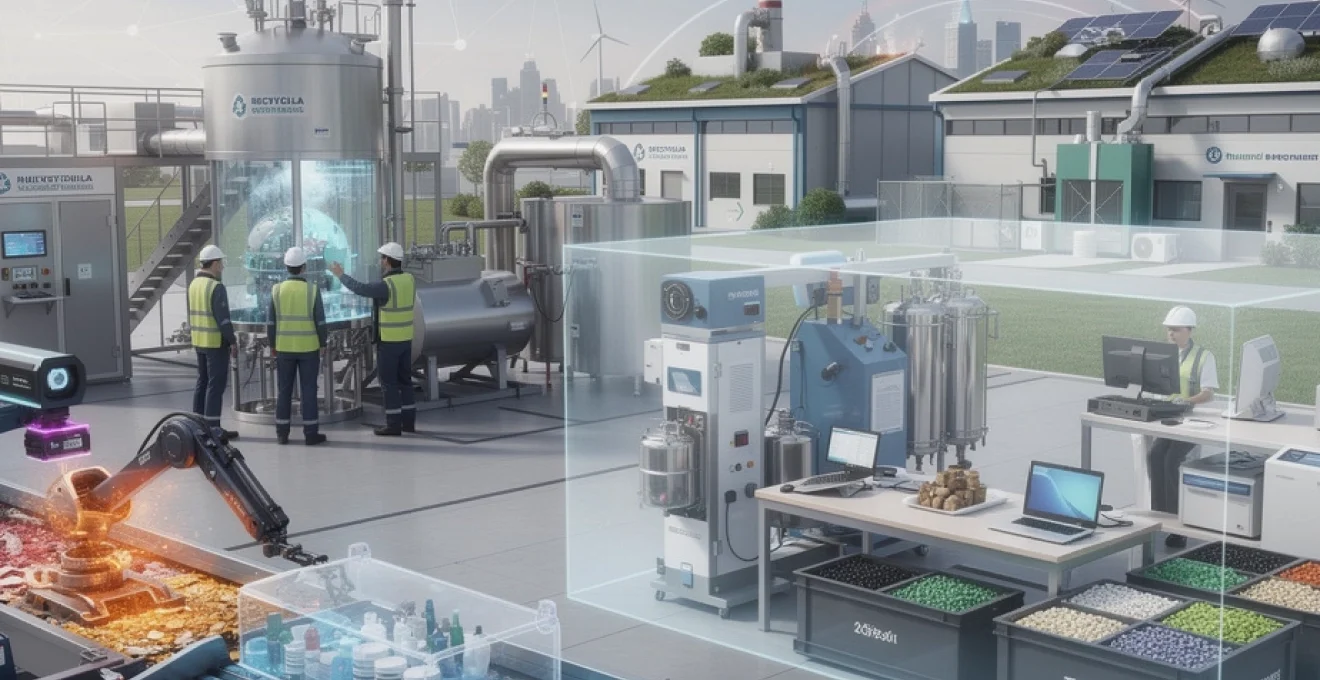
The global recycling industry stands at a pivotal moment where technological innovation meets environmental necessity. With over 11.2 billion tonnes of solid waste generated worldwide annually and only 9% of plastic production currently recycled, the urgency for more efficient processing methods has never been greater. Modern recycling facilities are undergoing a transformation that combines cutting-edge automation, advanced material science, and digital integration to maximise resource recovery whilst minimising environmental impact.
Today’s recycling infrastructure represents a sophisticated ecosystem of interconnected technologies designed to extract maximum value from waste streams. From AI-powered sorting systems that can distinguish between thousands of material types to chemical processes that break down complex polymers into their original building blocks, the industry is rapidly evolving beyond traditional mechanical separation methods. These advancements are not merely incremental improvements but represent fundamental shifts in how society approaches waste management and resource recovery.
Advanced mechanical sorting technologies revolutionising material recovery facilities
Material Recovery Facilities (MRFs) across the globe are experiencing unprecedented technological upgrades that dramatically improve both sorting accuracy and processing throughput. These facilities, which handle millions of tonnes of mixed recyclable materials annually, rely on increasingly sophisticated equipment to separate valuable materials from contaminated waste streams. The integration of multiple sensing technologies creates a comprehensive detection system that can identify materials based on chemical composition, density, colour, and even surface texture.
Modern sorting lines now incorporate cascading technology systems where materials pass through multiple separation stages, each designed to target specific waste categories. This multi-stage approach ensures that valuable materials previously destined for landfill are captured and redirected into appropriate recycling streams. The economic impact is substantial, with advanced MRFs reporting material recovery rates exceeding 95% compared to 70-80% achieved by conventional facilities.
Near-infrared spectroscopy integration in tomra autosort systems
Near-infrared (NIR) spectroscopy has emerged as a game-changing technology for plastic identification and separation within recycling facilities. These systems emit infrared light across material streams, analysing the reflected wavelengths to determine precise chemical compositions. The technology can distinguish between different polymer types, including PET, HDPE, PP, and PS, with accuracy rates exceeding 98%. This precision enables facilities to produce high-purity recycled material streams that meet stringent quality standards for manufacturing applications.
The integration of NIR systems into conveyor-based sorting lines allows for real-time material identification at processing speeds of up to 15 metres per second. Advanced algorithms process spectroscopic data instantaneously, triggering pneumatic ejection systems that precisely redirect identified materials into designated collection areas. This automated approach eliminates human error whilst dramatically increasing processing capacity, with modern installations capable of handling over 10 tonnes of material per hour per sorting line.
Optical density separation using pellenc ST’s mistral+ technology
Optical density separation represents a sophisticated evolution in material sorting technology, combining visual recognition systems with density-based separation principles. The Mistral+ technology utilises high-resolution cameras equipped with advanced image processing algorithms to identify materials based on visual characteristics, including transparency, colour variations, and surface properties. This approach proves particularly effective for separating mixed glass streams and identifying contaminated materials that might compromise recycling quality.
The system’s ability to process materials in free-fall environments enables precise separation of lightweight contaminants from heavier recyclable materials. Air jet systems create controlled airflows that selectively divert materials based on their aerodynamic properties, achieving separation purities exceeding 99% for certain material categories. This technology addresses one of recycling’s most persistent challenges: the contamination of valuable material streams by lightweight packaging films and labels.
Artificial Intelligence-Driven robotic arms in AMP robotics installations
Artificial intelligence integration in recycling facilities represents perhaps the most significant technological leap in waste processing efficiency. AI-powered robotic systems combine machine learning algorithms with advanced computer vision to identify, classify, and physically separate recyclable materials with unprecedented precision. These systems continuously learn from processing data, improving their accuracy and adapting to new material types and contamination patterns over time.
The deployment of robotic picking systems addresses labour shortages whilst providing consistent, high-quality sorting performance. Modern installations feature robotic arms capable of making up to 80 picks per minute
and can operate around the clock with minimal downtime. Each arm is guided by high‑resolution cameras and neural networks trained on millions of images, enabling recognition of specific brands, shapes, and even partially obscured labels. In some AMP Robotics installations, robots have achieved up to 99% sorting accuracy on targeted fractions, recovering materials that would otherwise slip through traditional systems. As a result, facilities are not only increasing capture rates but also generating cleaner, higher‑value recycling streams that are more attractive to end markets.
From an operational standpoint, AI-driven sorting also provides a rich layer of data about the composition of incoming waste streams. Facilities can track what materials are entering the system, in what quantities, and how this changes over time. This insight helps operators adjust processing parameters, negotiate better contracts with suppliers, and identify new opportunities for material recovery. For you as a stakeholder, this means that investments in AI robotics are no longer just about automation; they also unlock powerful analytics that underpin smarter, more efficient recycling operations.
Eddy current separation enhancements in steinert EddyC systems
Metals recovery has long been a cornerstone of efficient recycling processes, and recent advances in eddy current separation are pushing performance even further. Steinert’s EddyC systems employ high-speed rotating magnetic drums to generate strong, alternating magnetic fields that induce eddy currents in non‑ferrous metals such as aluminium and copper. These induced currents create opposing magnetic forces that literally “kick” metals away from non‑metallic materials, allowing for rapid, contactless separation at industrial scale.
What differentiates the latest generation of EddyC systems is their refined rotor design and adjustable pole technology, which allow operators to fine-tune separation for different particle sizes and throughput rates. Facilities can now reliably recover very small metal fragments down to a few millimetres, boosting overall metal recovery yields by 10–20% compared with older systems. In practical terms, this means less valuable metal ending up in landfill and more high‑grade feedstock being returned to smelters, helping close the loop on metals in a genuinely circular economy.
Chemical recycling breakthrough methods for complex polymer waste streams
While advanced mechanical sorting has transformed how we handle common recyclables, it still struggles with complex plastics and multi‑layer packaging. This is where chemical recycling comes into play, offering pathways to break plastics back down into their molecular building blocks. Rather than treating plastic as a homogenous waste, these technologies view it as a rich feedstock that can be converted into new polymers, fuels or chemical intermediates. When optimised properly, chemical recycling can complement mechanical recycling, tackling difficult waste streams that would otherwise be landfilled or incinerated.
Chemical recycling methods are diverse, ranging from high‑temperature thermal processes to low‑temperature enzymatic depolymerisation. Each approach has its own strengths, feedstock requirements, and energy profile. As you consider the future of efficient and sustainable recycling, it’s useful to see chemical recycling not as a single solution, but as a toolbox of techniques designed to match different plastic waste challenges. Below, we look at several cutting‑edge methods that are already being deployed at commercial or demonstration scale.
Pyrolysis process optimisation in plastic energy’s thermal conversion plants
Pyrolysis is one of the most established forms of advanced recycling, particularly for mixed polyolefin waste such as films, sachets and flexible packaging. In Plastic Energy’s thermal conversion plants, plastics are heated in the absence of oxygen to around 350–500°C, breaking long polymer chains into shorter hydrocarbon molecules. The resulting “TACOIL” can be used as a feedstock in conventional petrochemical plants to produce new plastics, fuels or chemical products. This creates a closed‑loop route for plastics that are often considered non‑recyclable in mechanical systems.
Efficiency gains in recent years have come from better temperature control, improved reactor design, and continuous feed systems that reduce energy losses. By optimising residence time and mixing, operators can increase liquid yields while minimising the formation of char and off‑gases. When these off‑gases are captured and used to power the process itself, the overall energy balance of pyrolysis improves significantly. The challenge, and the opportunity, lies in ensuring that the net environmental impact of pyrolysis is lower than that of producing equivalent materials from virgin fossil feedstocks—a goal that is increasingly being verified through detailed life cycle assessments.
Depolymerisation techniques for PET bottles using carbios enzymatic solutions
Depolymerisation takes a more surgical approach to plastics recycling, targeting specific polymers and breaking them back down into monomers. Carbios has pioneered an enzymatic recycling technology for PET, the plastic commonly used in drinks bottles and textile fibres. Specially engineered enzymes operate at moderate temperatures and pressures to depolymerise PET into its original monomers, terephthalic acid (TPA) and monoethylene glycol (MEG). These monomers can then be purified and re‑polymerised into virgin‑quality PET, suitable for food‑grade applications.
This approach offers several efficiency and sustainability advantages over traditional mechanical recycling of PET. Because the depolymerisation process is highly selective, it can handle coloured, opaque and mixed‑textile PET waste that would normally be downcycled or rejected. You can think of it as taking apart a LEGO model and putting the original bricks back into the box, ready to be re‑used indefinitely. Early industrial trials indicate that with careful process control, enzyme recovery and reuse, enzymatic depolymerisation can achieve high yields with a relatively modest energy footprint, making it a compelling route for truly circular PET.
Solvolysis applications in BASF’s ChemCycling programme
Solvolysis, another form of chemical recycling, uses solvents to dissolve and separate specific polymer fractions from complex waste streams. Within BASF’s ChemCycling programme, solvolysis is being explored as a way to recover high‑quality polymers and intermediates from mixed plastic waste that is unsuitable for conventional recycling. By carefully choosing solvents and operating conditions, it is possible to selectively dissolve target polymers—such as polyamide or polyurethane—while leaving other materials intact for subsequent processing.
Once dissolved, polymers can be purified and either precipitated or further broken down into monomers. The advantage of solvolysis lies in its ability to preserve polymer chains or recover monomers with minimal degradation, resulting in recycled materials with properties comparable to virgin polymers. However, solvent management is critical for sustainability: closed‑loop solvent systems, efficient recovery, and low toxicity are essential to ensure the process delivers genuine environmental benefits. When these conditions are met, solvolysis can unlock value from previously intractable plastic fractions, increasing overall recycling rates and reducing dependence on virgin chemicals.
Gasification technology advances in enerkem’s waste-to-methanol facilities
Gasification takes an even broader view of waste, converting mixed residual materials into a syngas rich in hydrogen and carbon monoxide. Enerkem’s waste‑to‑methanol facilities use high temperatures and controlled amounts of oxygen or steam to transform non‑recyclable waste into syngas, which is then catalytically converted into methanol or other chemicals. Unlike incineration, which focuses on energy recovery, gasification aims to recover the chemical value of waste, turning it into versatile building blocks for fuels and materials.
Recent advances in gasification focus on improving feedstock flexibility, gas cleaning and process integration. Better pre‑treatment and reactor control allow plants to handle a wider range of waste types while still producing a consistent, clean syngas. Integrated heat recovery systems capture thermal energy from the process to drive other plant operations, improving overall energy efficiency. For municipalities and industries grappling with difficult residual waste streams, gasification can serve as a bridge between traditional waste‑to‑energy and fully circular material recovery, provided emissions and lifecycle impacts are carefully managed.
Closed-loop manufacturing systems eliminating linear waste models
Beyond the walls of recycling facilities, manufacturing systems themselves are being redesigned to support closed‑loop material flows. Instead of the traditional “take‑make‑dispose” model, companies are embracing product and system designs that keep materials circulating at their highest possible value. This shift is not purely theoretical; it is showing up in concrete business models, design standards and industrial collaborations that treat waste as a design flaw rather than an inevitability.
Closed‑loop manufacturing relies on several complementary strategies: designing products for disassembly and recycling, creating take‑back schemes, sharing resources between industries, and shifting from product ownership to service provision. As you’ll see in the following examples, these strategies can dramatically reduce waste, improve resource efficiency, and even open up new revenue streams, making sustainability a core driver of innovation rather than a cost to be managed.
Cradle-to-cradle design implementation in interface inc.’s carbon neutral flooring
Interface Inc., a global flooring manufacturer, has been a pioneer in applying cradle‑to‑cradle principles to commercial products. Their modular carpet tiles are designed so that materials can be recovered and cycled back into new flooring at end of life, rather than ending up in landfill. This involves carefully selecting recyclable and, where possible, bio‑based materials, eliminating harmful additives, and standardising components to simplify disassembly and recycling.
To support a truly closed‑loop system, Interface operates take‑back programmes that collect used tiles from customers and route them to specialised facilities. Here, face fibres and backing materials are separated and processed into feedstock for new products, reducing reliance on virgin nylon and backing compounds. Combined with renewable energy use and efficiency improvements, these strategies have helped the company significantly cut its carbon footprint per square metre of flooring. For building owners and designers seeking low‑carbon, circular materials, cradle‑to‑cradle certified products like these offer a practical, scalable option.
Industrial symbiosis networks in kalundborg Eco-Industrial park
The Kalundborg Eco‑Industrial Park in Denmark is often cited as the gold standard for industrial symbiosis, where the “waste” from one company becomes the resource for another. Over several decades, local businesses have developed a complex web of exchanges involving steam, process heat, water, gypsum, bio‑sludge and other by‑products. The result is a regional closed‑loop system that reduces material waste, cuts emissions and improves economic resilience for all participants.
For example, excess heat from a power plant is used to warm nearby homes and industrial facilities, while by‑products from pharmaceutical and enzyme production are valorised in agriculture and construction. This network functions much like a natural ecosystem, where outputs and inputs are matched to minimise losses. The lesson for other regions is clear: by mapping resource flows and encouraging collaboration between industries, we can convert linear waste streams into shared value chains, boosting both environmental performance and local competitiveness.
Product-as-a-service models in philips healthcare equipment lifecycle management
Product‑as‑a‑service (PaaS) models are another powerful lever for eliminating linear waste. Instead of selling equipment outright, companies like Philips Healthcare increasingly offer diagnostic imaging systems and other medical devices as long‑term service contracts. Hospitals pay for performance—such as uptime or scan capacity—while Philips retains ownership of the hardware throughout its lifecycle.
This shift in ownership changes the incentives around design and end‑of‑life management. Because Philips remains responsible for the equipment, it has a strong motivation to design systems that are durable, upgradeable and easy to refurbish. At the end of a contract, devices are taken back, components are harvested for reuse, and valuable materials are recycled in controlled conditions. For healthcare providers, this model can reduce capital expenditure and ensure access to the latest technology; for the environment, it means less premature scrapping and far better utilisation of materials over multiple product lifecycles.
Modular design strategies for dell technologies’ circular computing hardware
In the electronics sector, modular design is a key strategy for extending product life and improving recyclability. Dell Technologies has integrated circular design principles into several product lines, focusing on easy disassembly, standardised fasteners and clearly labelled materials. By making components such as batteries, storage drives and memory modules accessible and replaceable, Dell enables simpler repairs and upgrades, delaying the need for full device replacement.
At end of life, these same modular features support efficient recycling. Devices can be quickly disassembled, with high‑value components and materials channelled into dedicated recycling streams. Dell’s take‑back programmes and partnerships with certified recyclers further ensure that recovered metals and plastics re‑enter manufacturing cycles. For organisations looking to reduce electronic waste and support a circular computing strategy, specifying modular, repairable hardware is one of the most direct, practical steps you can take.
Energy recovery optimisation in thermal treatment processes
Even in a future dominated by high‑performing recycling systems, some residual waste will remain. For these fractions, thermal treatment processes such as modern waste‑to‑energy plants and advanced combustion systems can play a role, provided they maximise energy recovery and minimise emissions. The focus today is on turning these facilities from simple incinerators into integrated energy hubs that support district heating, electricity generation and, increasingly, industrial steam supply.
Efficiency improvements come from technologies such as combined heat and power (CHP), flue gas condensation, and advanced boiler designs that extract more usable energy from each tonne of waste. In countries like Denmark and Sweden, well‑designed waste‑to‑energy plants routinely achieve energy utilisation efficiencies above 80% when supplying both heat and electricity. At the same time, stringent emission controls—using filters, scrubbers and continuous monitoring—help ensure that air quality impacts remain low. While energy recovery should never replace efforts to reduce and recycle waste, optimised thermal treatment can provide a useful safety net within a broader circular economy strategy.
Blockchain integration for supply chain transparency in recycling networks
As recycling systems become more complex and globalised, transparency and trust in material flows are crucial. How can manufacturers be sure that the recycled content they pay for is genuine, or that waste is handled responsibly along the entire chain? Blockchain technology offers one compelling answer by creating tamper‑resistant, shared ledgers that record each step in a material’s journey from collection to re‑manufacturing.
In pilot projects around the world, recyclers, brand owners and certification bodies are using blockchain platforms to track bales of plastic, metals and paper through sorting, processing and conversion stages. Every transaction—such as weighing, quality testing or change of custody—can be logged as an immutable record. For you as a buyer of recycled materials, this means improved confidence in recycled content claims and better visibility of supply chain risks. For waste managers and processors, it can simplify compliance reporting and open doors to premium markets that reward verified, low‑carbon materials.
Of course, blockchain is not a magic solution; it depends on robust data entry and integration with physical tracking technologies like QR codes, RFID tags or IoT sensors. Yet, when implemented thoughtfully, it can knit together fragmented recycling networks and support new business models, such as tokenised incentives for households that separate waste accurately. In that sense, blockchain acts like a transparent backbone for the circular economy, making invisible flows of materials and carbon visible and verifiable.
Carbon footprint reduction metrics through advanced recycling infrastructure
Underlying all of these innovations is a single, pressing question: how much do they actually reduce environmental impact, particularly carbon emissions? To answer this, recycling operators and policymakers are increasingly turning to robust carbon footprint metrics based on life cycle assessment (LCA). Rather than assuming that recycling is always better, LCA compares the full environmental costs of advanced recycling infrastructure against conventional waste management and virgin material production.
Well‑designed recycling systems can deliver significant carbon savings. For example, recycling aluminium can cut energy use by up to 95% compared with primary production, while high‑quality plastics recycling often halves the carbon footprint of virgin resin. However, as chemical recycling and energy‑intensive processes scale up, it becomes even more important to track actual performance. Metrics such as kilograms of CO2‑equivalent saved per tonne of waste processed, or carbon intensity per kilogram of recycled material produced, help identify where processes need optimisation and where they genuinely support net‑zero pathways.
For businesses and municipalities, integrating these metrics into procurement and policy decisions can be transformative. By specifying minimum recycled content with verified carbon savings, or by prioritising contracts with facilities that demonstrate best‑in‑class energy efficiency, you can directly steer markets toward more sustainable recycling solutions. In practical terms, this means moving beyond simple recycling rates and embracing a richer set of indicators that capture both quantity and quality of environmental benefits—ensuring that as recycling processes become more efficient, they also become truly sustainable in the long run.